Palmerston North, that windswept hub of the Manawatū where often the existential bafflement (mainly of its weather) has the good folk, affectionately called the Bucket Heads, scratching their heads (if they could under the green Manawatū Turbos buckets) at the day’s long episode of grey clouds.
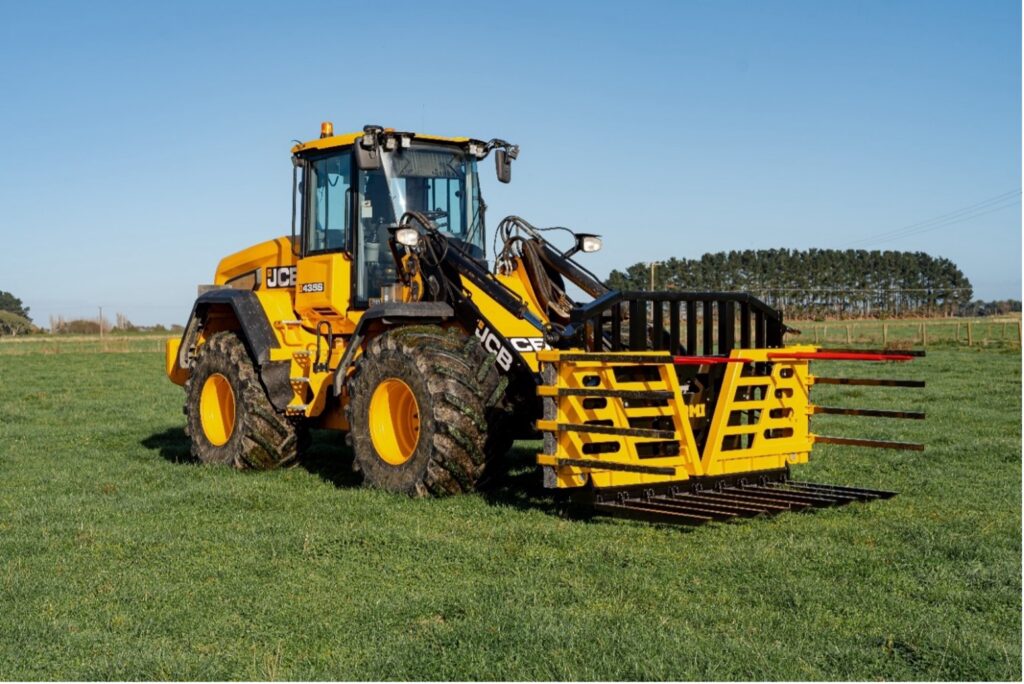
I went to university there, so I am not belittling the great city. However, it does have strange weather. What is not strange or confusing however is the good folk at RMI Engineering. This is where I pay an unreasonably close attention to a silage implement, RMI’s very own buckrake. Not just any buckrake, mind you. The English and Irish have sent their forks over to confront our sprawling paddocks and Olympic-scale silage pits. However, in true Kiwi can-do attitude, RMI have marinated over some contractors’ feedback and decided: ‘you know what, it’s time Palmerston North rolled up its sleeves, dusted off the wind, and set about building a buckrake that could outlast a government inquiry’. This yellow and black beauty is the lovechild of that great feedback and RMI’s ability to engineer greatness.
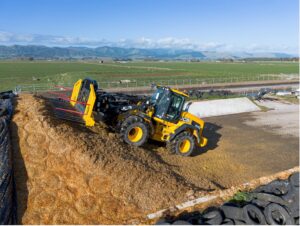
For months, Kiwi contractors have been putting the prototype through its paces, first maize then grass. We went to check out the prototype for ourselves, noting there have been some changes from that first production, and RMI have now teamed up with another fantastic Manawatū company, Strautmann Hopkins, who will be distributing these machines for contractors to push silage all over this fine nation.
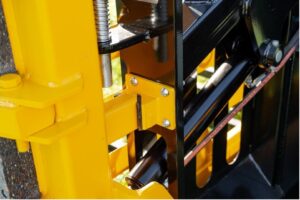
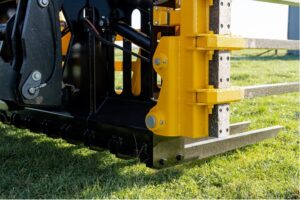
Well hopefully not an actual fork in the road/ground, but God forbid this does happen – bolt-on tines are the differentiator here for the RMI. Imagine, if you will, tines so cunningly bolted that you could swap them in the field, with no engineer required.
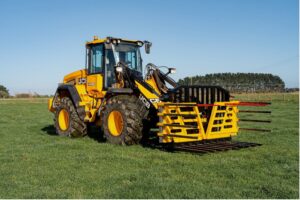
It always starts with the tines. If you talk to the stack magicians, they just love looking at the tines – give me long solid tines all day and that’s all they look at when shaking and shaping these silage mountains that rise up like the pyramids of Egypt. The 17 rock solid tines are made of Hardox 500, the whole tine, not just the tips, often considered the ‘superman of steel’ (or maybe I just made that up; it has a nice ring to it though, doesn’t it?).
“Silage stacks emerge so square and tight your neighbour will consider bringing the spirit level over”
Speaking of tips, the ends are special spoon-shaped, where the business end of the job lies. Thicker at the tip, as if anticipating a hard life, they wear slower during the constant scraping along the concrete silage pit floor. Now a point for the train spotters here, as this was the prototype, the most changes made have been in the tine department.
These tines are 1450mm long – the new ones are 1750mm. They are also flipped over for easy scraping off the pit floor, and the bolts now go through the tine vertically rather than horizontally. The replaceable nylon wear plates on the bottom plate that spans between the tines have also been beefed up. This allows for a solid base plate for that all important, square sided patting compaction.
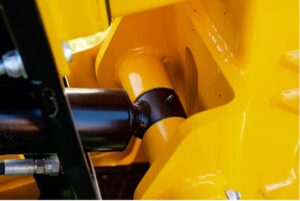
The pivots and pins are equally as substantial, not hoping like some, that a diet of Weet-Bix and optimism will see them right. Boasting a 60mm diameter pin, and with 320mm between bearings, it’s built to take more torque than a Facebook comments section. This is not a place for weakness or philosophical doubt.
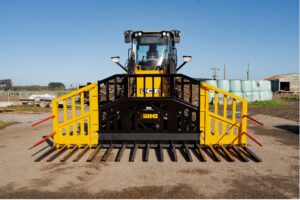
The wings, both folded and unfurled, are steadied by a C type locking system; so robust it would hold together a coalition government.
Fold it to 2975mm to push like you mean it, or swing out to a mighty 4200mm for a full 8m³ of silage moving and compacting your way, to make those stacks look like they have been packed by an OCD architect. Two hydraulic rams, an equaliser, and visibility better than average thanks to slightly angled RHS, which means the sun or light glare doesn’t impede your vision. It’s sounds silly but it works a treat.
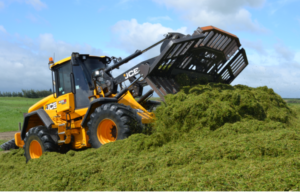
Complete with either Volvo or JCB brackets, we decided to hook the RMI Buckrake up to a JCB Farm Master and let the magic happen. Thanks to the team at Gopperth Contracting, we tested it on the JCB 419 and the 435, both in loader wagon and fine chopped grass and stacked in a pit and bun. In short, literally every silage scenario we could find, and the results were consistently the same: folded up for those moments of precision, or wings fully extended for a display in a brute agricultural ballet when it moves up to 8m³ of silage in a single, defiant sweep.
Silage stacks emerge so square and tight your neighbour will consider bringing the spirit level over. In short, The RMI Buckrake represents local engineering by local legends, distributed by a family business with a keen eye to help with Kiwi solutions.
If you want longer tines? No worries. Different colours? No dramas. Being designed and manufactured right here in New Zealand means you can get the customisation you want. All silage making roads lead to the Manawatū folks.
Manawatū company, Strautmann Hopkins, will be distributing the RMI Buckrakes around New Zealand
Originally published by FarmTrader